

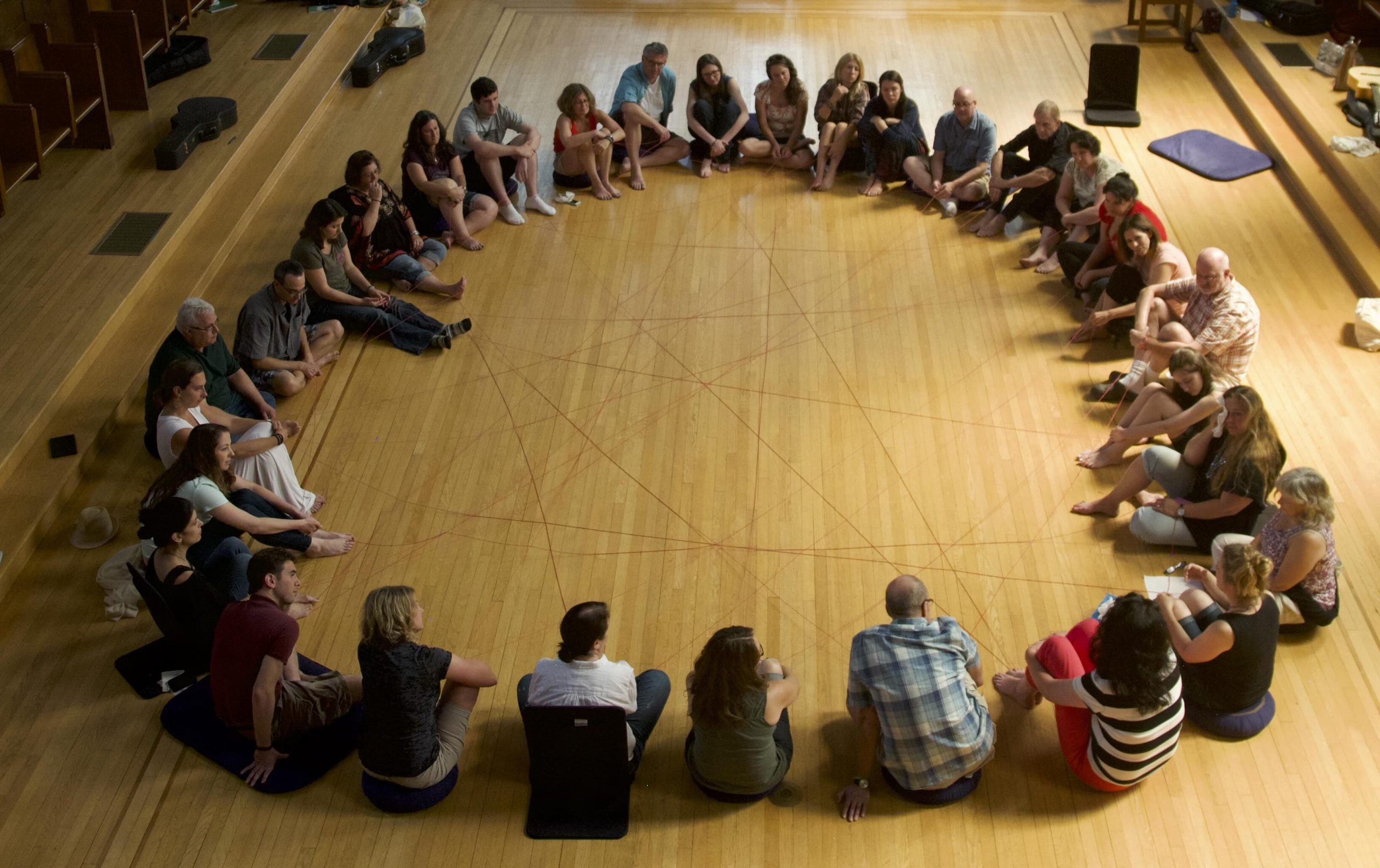
Sharing Notes and Exploring Future Directions
PURPOSE
The purpose of the Garrison Institute’s initiative is to map, convene, and nurture an emerging community of educators committed to advancing inner transformation for systems change in higher education. Business and management education are an especially important starting point because they prepare many of the people who will shape organizations and institutions.
WHY NOW?
We live in a world of increasing economic, social, political, and environmental turbulence, compounded by the profound uncertainties introduced by artificial intelligence. Businesses and other institutions are both shaped by these conditions and implicated in their creation. They may contribute to the problems we face, but they also have the potential to help address them. These conditions invite us to reconsider not only what students need to know and be able to do, but also who they are becoming.
WHAT IS INNER DEVELOPMENT?
Inner development concerns the formation of the whole person: developing ways of knowing, being, relating, and acting that enable people to respond wisely and responsibly in circumstances they cannot fully predict or control. It can cultivate curiosity, discernment, moral imagination, humility, openness to uncertainty, compassion, courage, agency, and the wisdom to recognize when to act (and when not to act).
This work invites students to ask not only, “What do I want to achieve?” but also, “What am I called to contribute? Whom does my work serve? What kind of person am I becoming?” It can deepen awareness of interdependence, the dignity and distinctive gifts of others, and our participation in communities and systems larger than ourselves.
Drawing on contemplative and spiritual traditions as well as humanistic and psychological approaches, educators approach inner development through reflection, dialogue, contemplation, meditation, prayer, service, experiential learning, and other forms of inquiry. These practices may be grounded in religious or spiritual traditions or may be entirely secular.
HOW ARE INNER DEVELOPMENT AND SYSTEMS CHANGE RELATED?
The relationship between inner development and systems change is reciprocal. The systems we hope to change also live within us. Assumptions about growth, productivity, achievement, accumulation, status, and success shape not only our institutions but also what we learn to value and desire. Inner development and systems change are mutually reinforcing dimensions of change.
WEAVING AN EMERGING COMMUNITY
Through mapping, convening, research, and publication, the Garrison Institute aims to weave diverse strands into a community of inquiry and practice. We seek coherence without convergence: enough shared questions, purposes, and language to recognize one another’s work, learn from it, and build upon it without requiring everyone to adopt the same framework.
OUR ASPIRATION
Ultimately, our aspiration is to advance higher education in which inner development and systems change reinforce one another, serving the common good and contributing to a more just, sustainable, regenerative, and flourishing world.
****Please do not forward the link to this registration portal. The gathering is invitation-only****
 | |
|---|---|
| Friday February 20 | |
| 3.00 – 6.00 | Check In |
| 6.00 – 6:30 | Welcome |
| 6:30– 8.00 | Dinner |
| 8.30 – 9.30 | Introductions |
| Saturday February 21 | |
| 7.00 – 7.30 | Optional Meditation session |
| 7.30 – 8.30 | Breakfast |
| 9.00 – 10.30 | Panel 1: Brief remarks by the speakers – followed by Q&A & General Discussion Moderator: Michael Pirson (Fordham) Speakers: Jeremy Hunter (Claremont), Jody Fry (Texas A&M), Ina Gjikondi George Washington) & Andrea Prebys-Williams (Presidio) |
| 10.30 – 11.00 | Break |
| 11.00 – 12.30 | Break out groups followed by general discussion |
| 12.30 – 1.30 | Lunch |
| 1.30 – 3.00 | Panel 2: Systemic Change Brief remarks by the speakers – followed by Q&A & General Discussion Moderator: Otto Scharmer (MIT) Speakers: Lindsey Goodwin (Champlain), Stu Hart (Michigan), Brian Trelstad (Harvard), Trevor Zink (Loyola Marymount University) Brief remarks by the speakers – followed by Q&A & General Discussion |
| 3.00 – 3.30 | Break |
| 3.30 – 5.00 | Break out groups followed by general discussion |
| 5.00 – 6:30 | Break |
| 6:30 – 8.00 | Dinner |
| 8.30 – 9.30 | General Discussion |
| Sunday February 22 | |
| 7.00 – 7.30 | Optional Meditation session |
| 7.30 – 8.30 | Breakfast |
| 9.00 – 10.30 | Panel 3: Navigating Business Schools Brief remarks by the speakers – followed by Q&A & General Discussion Speakers: Raj Sisodia (Tec de Monterey), Abby Schneider (Regis), Daniela Senkl (Guelph) & Jason Jay (MIT) |
| 10.30 – 11.00 | Break |
| 11.00 – 12.30 | Break out groups followed by general discussion |
| 12.30 – 1.30 | Lunch |
| Departure Post-Lunch | |
LEAD FACILITATOR

Rebecca Henderson is one of 25 University Professors at Harvard, a research fellow at the National Bureau of Economic Research and a fellow of both the British Academy and of the American Academy of Arts and Sciences. She has more than twenty-five years of major public board experience. Rebecca’s research explores the degree to which the private sector can play a major role in building a more sustainable economy. Her publications include Accelerating Energy Innovation: Insights from Multiple Sectors (University of Chicago Press), Leading Sustainable Change: An Organizational Perspective (Oxford University Press) and Political Economy and Justice (University of Chicago Press). She is also the author of Reimagining Capitalism in a World on Fire which was shortlisted for the FT/McKinsey 2020 Business Book of the Year Award.
_______________________________________________________________________________________________________________________________________________
ACCOMMODATIONS
There are Single, Double rooms available. Please note, there is no available guest elevator and all rooms are accessible by stairs—except for those reserved for the mobility-impaired on the first floor. There are two communal bathrooms on each residential floor as well as a comfortable lounge with sofas and easy chairs, where tea and instant coffee are available. The lounges also are equipped with wireless, high-speed internet connection. There are several local hotels within driving distance from the Institute, for those who wish to stay off-site, as commuters. Onsite meals are included with commuter registrations.