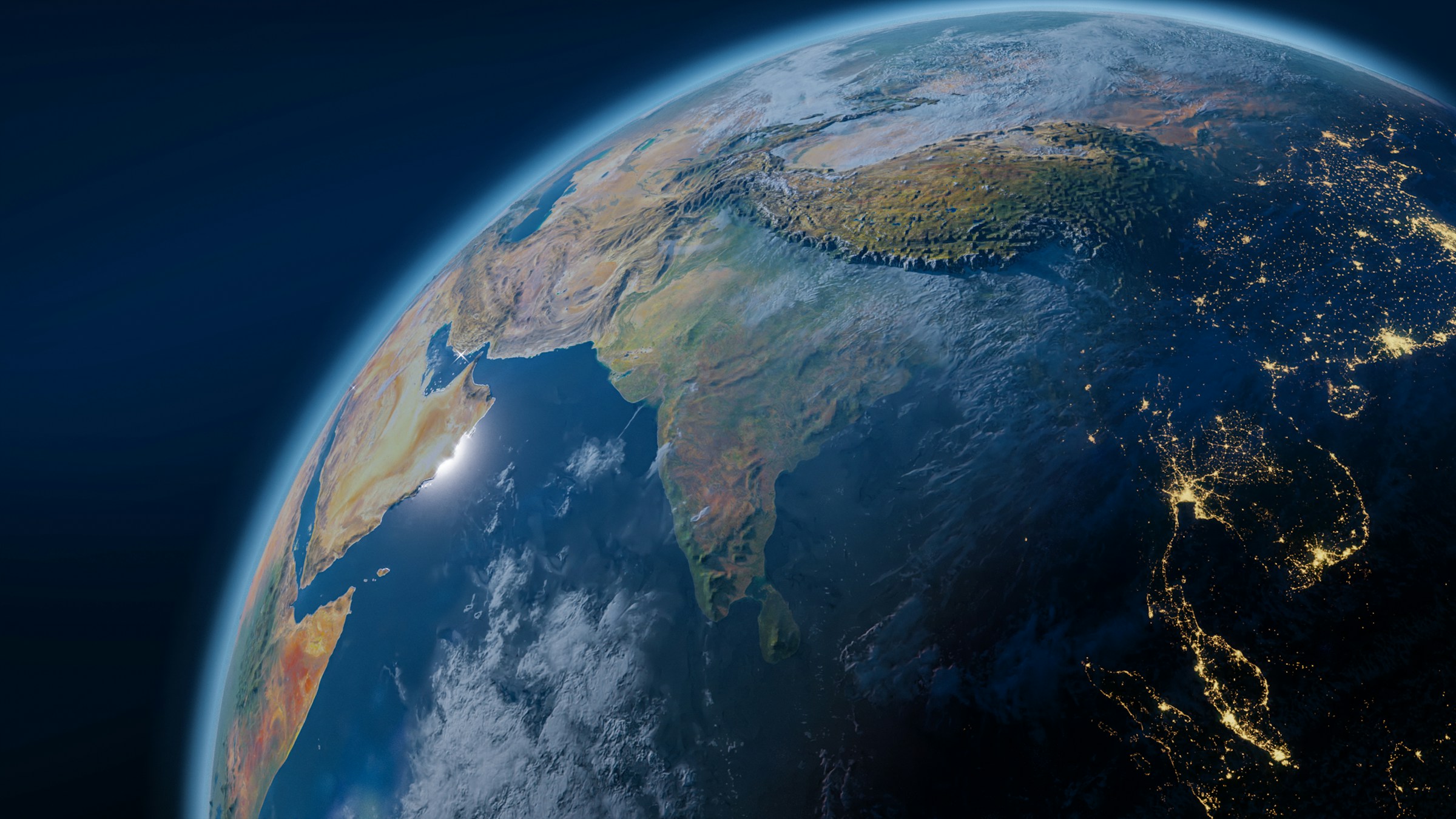
The Garrison Institute and the Yale Forum on Religion and Ecology are co-hosting a 4-part virtual speaker series on Living Earth Community. This series offers space for participants to deepen their understanding of the living Earth and renew their sense of belonging during times of ecological uncertainty and social fragmentation.
To discover more about the ideas behind the series, we corresponded with Mary Evelyn Tucker, PhD, co-founder of the Yale Forum on Religion & Ecology alongside John Grim, and Sam King, project manager of the Journey of the Universe Project. We discussed what becomes possible when Indigenous traditions, ecological science, philosophy, spirituality, and the arts are brought into conversation; how seeing ourselves as members of a larger Earth community can transform our sense of identity; and what this perspective might offer younger generations facing an increasingly complex ecological and social landscape.
Living Earth Community draws on many different ways of knowing—from Indigenous traditions and ecological science to philosophy, spirituality, and the arts. What happens when we bring these different ways of understanding the living world into conversation with one another?
Sam King: Ecologists tell us that the boundaries between ecosystems–known as ecotones–are often the most biodiverse, as seen in tidal estuaries or mangrove forests. Living Earth Community offers a similar sense of encounter, bringing together contemporary science on the complex lives of plants, trees, and fungi with ancient spiritual and philosophical understandings of an animate and communicative Earth community. In the words of Thomas Berry, these streams of knowing, together, help to transform our sense of reality from “a collection of objects” to a “communion of subjects”–a shift that is essential if we are to find our way forward within the wider Earth community.
Any adequate and culturally resonant response to the ecological challenges we face depends on harnessing the wisdom of these diverse ways of knowing, as science and systems thinking converge with Indigenous cosmovisions and religious worldviews. Through this alchemical mixing, creative responses can emerge, inner resilience can be cultivated, and unlikely allegiances can be forged for the well-being of our shared planetary home.
The idea of a Living Earth Community asks us to see humans as one part of a larger community of life. How does this way of seeing the Earth (and ourselves) change how we experience our lives and how we act?
Mary Evelyn Tucker: If we lose this perspective of being part of a larger community of life, we lose something of our very identity. In our search to find where we belong and why we are here, we often get caught in our social, political, or religious identities. This is our small self rather than our larger self. Thus, what a Living Earth Community context offers us is our deeper identity, our cosmological and ecological being of belonging to something larger. This is our great self. We are not just persons of a nation-state but persons of a bioregion, belonging to a local watershed and living on a continent of diverse ecosystems, connected to oceans of immense depth and robust life forms.
As we image ourselves outward in concentric circles, we see that we belong to a life community that gives us sustenance of water to drink, air to breathe, soil to plant. Without this we cannot live. This realization changes who we are and how we interact with each sentient being–human and more than human. It is an awareness that is deeply embedded in Indigenous knowledge and lifeways. It is also embedded in Asian religious traditions and cultures.
We’re at a moment when ecological crisis, technological change, and social fragmentation are all reshaping the way we understand our place in the world. What does the Living Earth Community offer that you think is missing from the dominant conversation today?
Mary Evelyn Tucker: We are immersed in the polycrisis of interacting problems that seem to overwhelm our ability to imagine effective solutions. For example, complex environmental problems cannot be solved by science, policy, law, technology, or economics alone, as valuable as these are. These arise from siloed perspectives that cannot see the whole. Living Earth Community offers a holistic perspective of a unified perception of relationality and kinship. Humans are clearly an integral part of nature and cannot have health or wellbeing apart from it. The renewal and regeneration of life systems is essential to a Living Earth Community.
As the noted conservationist Aldo Leopold wrote in Sand County Almanac, “The most important characteristic of an organism is that capacity for internal self-renewal, known as health.” We have interrupted that capacity for renewal and subjected both humans and more than humans to unhealthy conditions. We have created polluted water, air, and soil. Leopold calls us back to a sensibility of reverence and respect with his land ethic, namely, “A thing is right when it tends to preserve the integrity, stability and beauty of the life community. It is wrong when it tends otherwise.”
What do you think are the challenges the younger generation of people interested in this work will face that the older generation did not? What do you think we’re uniquely positioned to bring to this work?
Sam King: Younger people are faced with intersecting ecological crises at a scale no previous generation has faced. The world’s wildlife has decreased about 73% since 1970. Microplastics pervade human brains, breast milk, and the blood of newborn babies. Human-caused climate change has spiked global temperatures about 1.3° since 1850, causing unpredictable droughts, wildfires, and extreme weather events that widen social inequalities.
And these challenges are taking a toll on youth mental health. According to a 2022 Lancet study, 45% of young people (ages 18-25) said that climate change negatively affects their daily life and functioning, while 75% said “the future is frightening.” Young people have the passion, creativity, and vision to birth a more just and regenerative world, because our future depends on it. We have the digital savvy to seed ecological transformation across cultures and bioregions. Through young leaders like Greta Thunberg and Xiye Bastida, we see a grassroots movement to birth a more healthy and vibrant future beyond petroleum-based business as usual; a world of shared flourishing where, in the words of the Earth Charter, “the protection of Earth’s vitality, diversity, and beauty is a sacred trust.”
Learn more and register for the donation-based 4-part virtual speaker series from Aug. 26 – Oct. 28.
Visit the Living Earth Community website.
Recommended Reading:
- Sacred Depths of Nature by Ursula Goodenough
- The Light Eaters, Zoe Schlanger
- Works on Religious Naturalism by Carol Wayne White
- Works of nature writing by Carl Safina, Amy Brady, Willow Defebaugh
- Thomas Berry, The Sacred Universe, where he elaborates on his notion that “the Earth is not a collection of objects but a communion of subjects”