Rekindling Hope and Our Love for Earth: A Celebration of the Earth Charter’s 25th Anniversary
By Stephen Posner, PhD
In late 2025, nearly 1,000 people gathered at Shelburne Farms in Vermont to renew our love for Earth and rekindle collective hope during uncertain times. The spirit of this gathering was full of love, inspiration, and intergenerational exchange.
The event emerged organically, envisioned among friends over tea in the springtime of 2025, and shaped by a collaborative group that sought to bring together art, science, storytelling, music, dance, and deep reverence for Earth. The Garrison Institute’s Pathways to Planetary Health initiative was honored to partner alongside the Earth Charter community and our gracious host, Shelburne Farms.
One of the unique elements of this gathering was how we walked in the footsteps of legendary activists Jane Goodall and Satish Kumar, as well as hundreds of people who came together in the same place 25 years earlier to celebrate the origin of the Earth Charter.
As a member of the organizing committee, I was grateful to be invited to offer and lead several components of the day: the opening mindful walk, a session sharing teachings from Indigenous activist Tiokasin Ghosthorse, a panel integrating youth and elder voices in dialogue on hope, and the closing tree blessing.
Gathering together with a mindful walk
We began simply–by moving as one body.
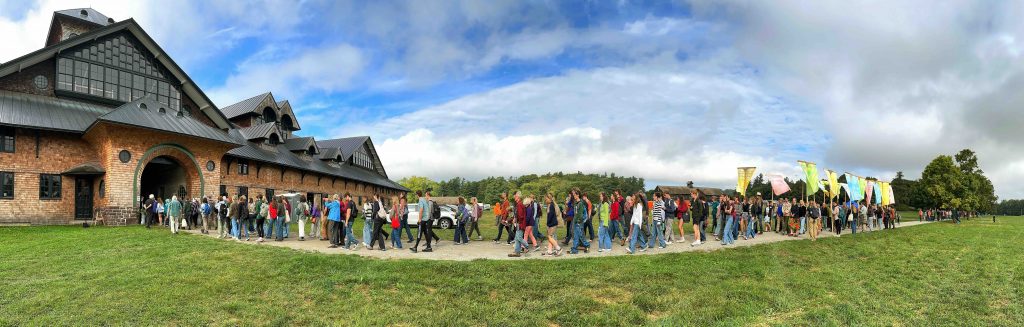
On a Sunday morning, we gathered on Tree Lane for welcoming words and a mindful walk. Musician and composer Paul Winter began playing as the walk commenced, offering nature-inspired music for the crowd to settle into silence and presence.
I drew on mindful walking practices I first learned at Plum Village, where Zen Master Thích Nhất Hạnh taught that we don’t walk to get somewhere else–we walk to arrive with each step and “walk as if you are kissing the Earth with your feet.”
A small (and important) lesson landed almost immediately: I started walking with an open heart and holding hands with children–but a bit too quickly for the pace of hundreds of people moving together. The collective had its own speed–slower, more spacious, more relational. So, we adjusted in a way that felt like an early teaching from the day itself: If hope is something we practice together, it requires attunement to the shared pace of the whole.
“Something beautiful is happening here”: Tiokasin Ghosthorse on learning from Earth
A centerpiece of the day was a conversation with Tiokasin Ghosthorse, recorded and shared because he was teaching remotely from home at the time. I introduced him the way he once greeted me in Old Lakota: “Something beautiful is happening here.” It felt like a blessing, a reminder, and a fitting description for the gathering itself.
Several themes were woven into our session, a mix of live context-setting and recorded teachings, including one that will stay with me for years: “We need to stop learning about the Earth and start learning from Earth.” Earth is not just an object of study, but a teacher; not something “out there,” but rather a living presence we are in relationship with–right here and now.
Tiokasin acknowledged these realities and invited us into questions that reached beneath the surface of contemporary environmental discourse:
- What does it mean to reinterpret “human being” through an Indigenous lens?
- How do language and worldview shape whether we speak about Earth (at a distance) or speak from Earth (in relationship)?
- What becomes possible when we listen–not only with our ears or our hearts, but “with every cell of the body?”
His invitation toward humility and openness set a tone: “To consciously apply mystery to everything, knowing that we will never know the answer.”
The Earth Charter, a living document across generations
Early in the program, a letter from Steven Rockefeller was read aloud by his grandson. Steven is a member of the Earth Charter Commission and was the first Chair of the Earth Charter International Drafting Committee.
The intergenerational transmission was palpable. Steven quoted the Earth Charter’s Preamble, calling on all peoples “to bring forth a sustainable global society founded on respect for nature, universal human rights, economic justice, and a culture of peace.”
He also spoke directly to the emotional and political texture of our time, urging participants not to give in to despair and naming the need to “renew and intensify collaborative action.” And he expressed gratitude that so many students and young people were present–recognizing their commitment, creativity, and leadership as critical.
Later, two panels helped carry this intergenerational thread forward. In the morning, voices including Mary Evelyn Tucker, Gus Speth, and Sam King reflected on the ethics of care and planetary responsibility.
In the afternoon, Amanda Janoo, Keetu Winter, Amanda Bennett Rivera, and Peter Blaze Corcoran further integrated the voices of elders and youth and created space for dialogue about hope grounded in diverse, lived experiences.
The Earth Charter’s four pillars–Respect and Care for the Community of Life; Ecological Integrity; Social and Economic Justice; and Democracy, Nonviolence, and Peace–were interpreted by panelists who ranged in age from their 20s to 80s. One panelist was at the original gathering when she was 5.
This structure brought together views from across life stages into an integrated ethical framework for living well on a shared planet.
Art as the carrier wave
One of the most striking features of the day was the way art carried meaning and reached places that analysis alone cannot grasp. Music was woven throughout, with soaring songs from Paul Winter and improvisational cello from Dave Haughey, performances that helped set the tone and rhythm for collective attention.
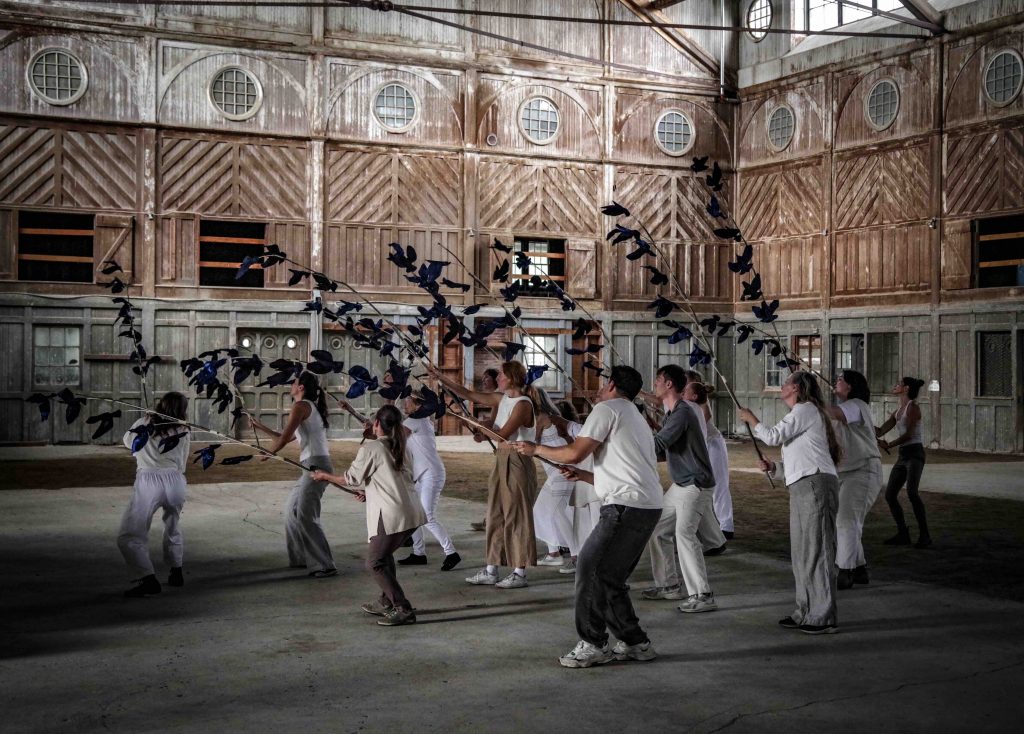
We also experienced a “Murmuration Dance,” choreographed by Lauren Jenkins to invoke the coordinated and complex motion of starlings in flight that form enchanting patterns in the sky. The closing sequence was equally powerful, featuring artist Sally Linder’s stories of the Ark of Hope’s origin and spontaneous global pilgrimage of peace.
Grounded hope: a practice, not a mood
Hope was one of the day’s central themes. It’s easy to revert to forms of hope that either bypass reality (“things will work out eventually”) or over-rely on control (“we can engineer our way out”).
Instead, the gathering oriented towards grounded hope: taking steps that are aligned with our values, even in the face of uncertainty.
For me, grounded hope requires that we:
- know our values
- honestly take stock of how our actions align with our values
- grow our relational capacities for acting together–especially across difference
- summon courage to act anyway, in the present moment, as an expression of care
This echoes something Tiokasin said about the Earth Charter: It matters to understand what we are saying and what we are living–not simply to hope things get better, but to practice a way of being that is aligned with relationship. This is a wise pathway to creating a more compassionate and resilient world.
A closing blessing: “If we surrendered to earth’s intelligence…”
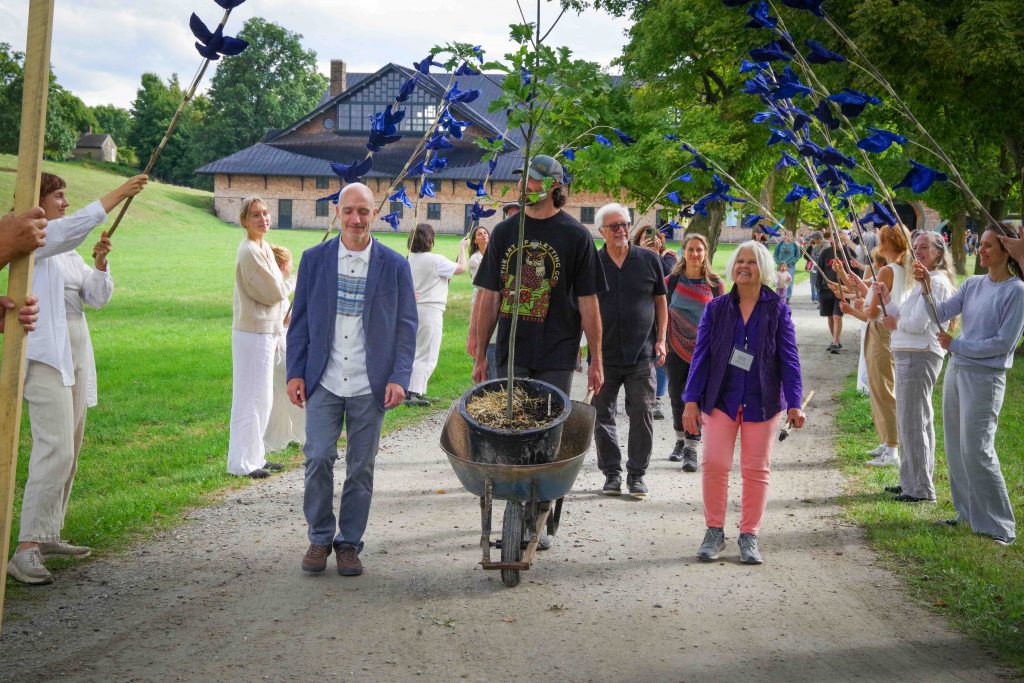
We ended with a blessing beside a young tree, placed alongside the hill where a now-maturing tree was planted at the original gathering 25 years ago.
The gesture was simple, and it carried deep symbolic weight: Seeds planted decades ago still growing; a new life placed into the same soil; an invitation to carry forward embers of life and hope. I shared a line from Rainer Maria Rilke as both mirror and medicine: “If we surrendered to Earth’s intelligence, we could rise up rooted, like trees.”
The gathering felt like an embodied commitment to carry some things forward–hope, collective effort, and love, so that these qualities may continue to rise up through our communities, our shared work, and our daily choices.
Thank you to the celebration organizing committee: Cameron Davis, Sally Linder, Sam Crowell, Amy Seidl, Nadine Canter, Megan Camp, and Tre McCarney.
For more from the event, watch the Murmuration Dance video followed by Bill McKibben’s remarks and the video of artist Sally Linder’s story of the Ark of Hope and remarks by the MC for the day, Professor Amy Seidl.
Stephen Posner, PhD, is Senior Fellow with the Pathways to Planetary Health initiative at the Garrison Institute, where he builds cross-sector collaborations that integrate evidence, values, and practices for planetary health.