

Mission
The Garrison Institute’s Bioregional Resilience Project brings together science, systems thinking, community listening and engagement, and contemplative practices to address community needs and strengthen resilience across the Mid-Hudson region.
Bioregional Resilience is the capacity of communities in a shared ecological region to adapt, collaborate, and thrive in the face of environmental, economic, and social change. Bioregions can be defined by natural boundaries, such as a watershed, forest system, mountain range, or climate zone, rather than constructed borders. They reflect the interconnected ecological patterns that shape how land, water, species, and human communities relate and function together.
Learn More
Bioregional resilience recognizes that resilience grows stronger when communities:
- Work together across socio-political boundaries, building trust and shared purpose.
- Learn from and align with natural systems — embracing ecological patterns, cycles, and limits as guides for adaptation.
- Protect, restore, and integrate nature-based systems that buffer risk and sustain life.
- Connect businesses, non-profits, local institutions and government to generate more vibrant economies.
- Shift food, energy, and economic systems towards greater diversity, redundancy, adaptability and local/regional integration.
- Collaborate across local networks and jurisdictions, ensuring that resources, knowledge, and strategies are shared in service of a more regenerative, sustainable, and equitable future.
Bioregional resilience helps communities better prepare for and respond to challenges such as climate change, resource pressures, economic shocks and natural disasters. Through relationship-building and thoughtful preparation, communities can better confront natural disasters with clarity, compassion, and collective strength.
How is the Mid-Hudson Valley bioregion defined?
Generally defined, the Mid-Hudson Valley bioregion is bound by the natural boundaries of the Hudson River watershed, including the river’s main stem and its tributaries, surrounding hills, forests, and floodplains from northern Westchester and Rockland counties, up through Dutchess and Ulster Counties.
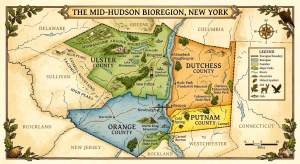
How is the Garrison Institute listening and responding to community needs?
Resilience begins with understanding a community’s challenges and opportunities, honoring the insights and work already underway already in communities. From this foundation, we work in partnership to strengthen connection, deepen understanding, and support sustained, collaborative resilience projects in communities across the region.
Learn More
- Workshops and Convenings: We host programs such as Columbia–Hudson Valley resilience workshops that bring together nonprofit leaders, municipal staff, and community practitioners. These experiences integrate evidence-based resilience frameworks, peer learning, and nature-based reflection to build skills in collaboration, leadership, and adaptive response, while also addressing wellbeing and resilience among frontline practitioners.
- Building Connections Across the Region: Identifying and connecting organizations and networks working across the Mid-Hudson Valley By illuminating who is doing what and where opportunities for alignment exist, we help foster a more connected, coordinated, and responsive regional community.
- Community Planning Support: We partner with municipalities and community-based organizations in developing and implementing resilience-oriented strategies. This includes facilitating cross-sector dialogue, helping translate priorities into actionable plans, aligning efforts with broader regional goals, and efforts to identify and secure funding for related initiatives.
- Library Partnerships as Community Anchors: We collaborate with libraries as trusted, accessible civic hubs to deliver resilience tools, resources, and training. These partnerships extend support directly into communities, strengthening practical skills, preparedness, and meaningful connection among residents. These partnerships extend support directly into communities, strengthening practical skills, preparedness, and meaningful connection among residents.
Across these efforts, our goal is to build long-term community resilience through an integrated approach where ecological insight, economic vitality and contemplative wisdom converge with community-based visioning to inform grounded action, strengthen relationships to place, and cultivate systems that are adaptive, regenerative, and rooted in shared stewardship of the region’s future.
What can I do to learn more?
Our Bioregional Resilience Resources include white papers, articles, frameworks, and guidance documents that translate complex systems thinking into practical tools for place-based planning, decision-making, and collaborative action. Our soon to be released Garrison Institute resilience toolkit will help communities learn and take action. For even more information and resources see the Garrison Institute’s Pathways to Planetary Health videos, podcasts, symposia going back to 2010.
For official program inquiries, please reach out to: bioregionalresilience@garrisoninstitute.org
We would love to hear from you!
If you have ideas for projects, partnerships, or how to strengthen bioregional resilience in the Mid-Hudson Valley, please reach out to Mary Lambert, Senior Fellow of Bioregional Resilience, at mary@garrisoninstitute.org.
“Bioregional awareness teaches us in specific ways. It is not enough to just ‘love nature’ or to want to ‘be in harmony with Gaia.’ Our relation to the natural world takes place in a place, and it must be grounded in information and experience.”
– Gary Snyder
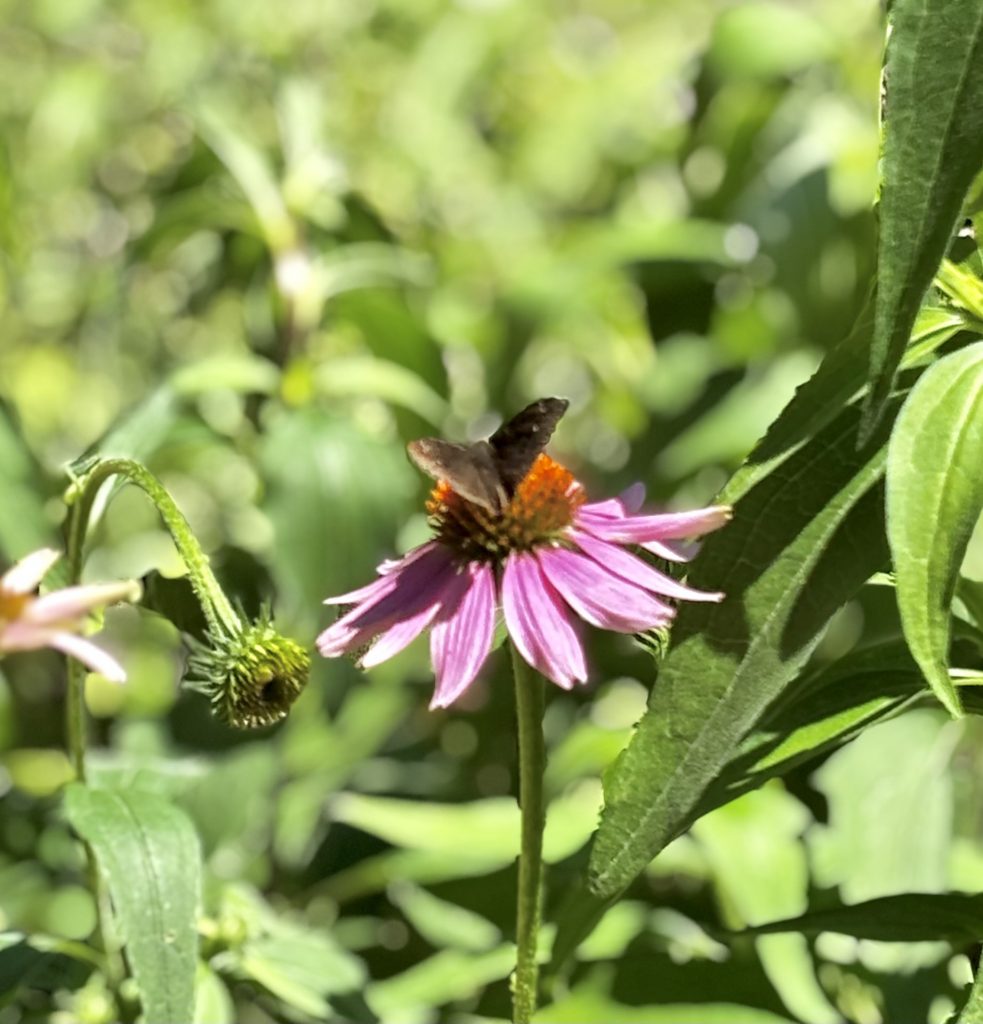
Partner Spotlight
Philipstown and Cold Spring Climate Smart Communities Task Forces
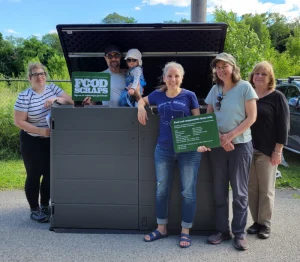
The Village of Cold Spring and The Town of Philipstown are both bronze certified Climate Smart Communities. Cold Spring Trustee Laura Bozzi (below center), Karen Ertl (below right) and other Philipstown Climate Smart Task Force members are assembled below at the food scraps drop-off container on Kemble Avenue.
Food scraps collected inPhilipstown and Cold Spring are processed at Sustainable Materials Management in Cortlandt Manor, which turns the food scrap into rich, reusable compost to be used to enhance soil at regional gardens and farms. This provides an example of a closed-loop system that not only strengthens regional soil health but community collaboration and resilience.
See the CSC Task Force pages for the Village of Cold Spring and for the Town of Philipstown to learn more about the many actions each have taken to help build resiliency in their communities. See their Food Scraps Program for more information on the Food Scraps program, or to get your starter kit.
Bioregional Resilience Research
The Garrison Institute’s work is grounded in an insight increasingly recognized in both ecological science and policy: Resilience grows not from efficiency alone, but from the quality of relationships, between people and place, between communities and their ecological systems, between local action and regional coordination. The “bioregion,” which we understand as a functional ecological unit rather than an administrative or government convenience, offers a framework for rebuilding those relationships at the right scale.
You May Also Be Interested In
Participate
-
Fall Community Gathering | Sept. 19 | In-Person
Engage
- The Contemplative-Based Resilience initiative, offering evidence-based tools for helping professionals to strengthen resilience and foster connection
Read
- Finding Awe in Nature by Stephen Posner in conversation with Kim Nolan