By Lily Rockefeller
Not every challenge in medicine has a clinical solution. Illness, grief, uncertainty, and loss all ask something of clinicians that extends beyond their ability to diagnose and treat: the capacity to be present in the face of suffering. The practice of contemplative care begins with the idea that this, too, is an essential form of care—and one that can be intentionally cultivated.
Rooted in Buddhist contemplative traditions but increasingly studied in clinical settings, contemplative care training helps clinicians cultivate presence, emotional awareness, and compassionate attention when tending to illness and suffering. In doing so, it strengthens the relational dimensions of care, helping patients feel seen, heard, and less alone while giving clinicians practical ways to sustain compassion without becoming overwhelmed by the suffering they encounter.
This emerging field is gaining empirical support. The New York Zen Center for Contemplative Care has developed one of the few peer-reviewed contemplative medicine training programs for healthcare professionals. Studies (2023 research and 2025 research) of participants in its yearlong Contemplative Medicine Fellowship found significant reductions in emotional exhaustion and depersonalization—the hallmarks of burnout—as well as increases in compassion, professional fulfillment, work-life integration, and values-aligned practice.
While the studies focused on clinician outcomes rather than patient outcomes, these are factors widely associated with higher-quality care. At a time when burnout continues to challenge healthcare systems around the world, the findings suggest that contemplative training may be an important complement to clinical education.
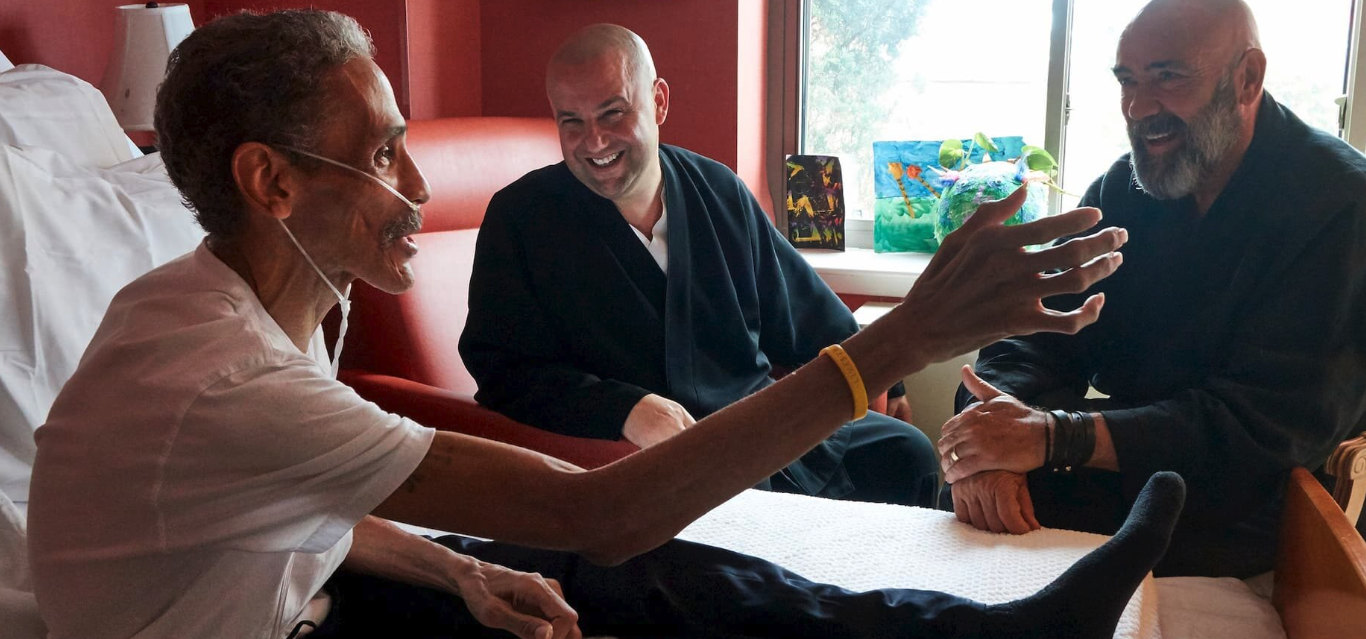
For many, this work begins on the meditation cushion. This September, the Garrison Institute welcomes the New York Zen Center back for its annual Contemplative Care Retreat, led by Chodo Robert Campbell Sensei and Koshin Paley Ellison Sensei. Through meditation, dharma talks, periods of noble silence, personal meetings with teachers, and shared meals, participants are invited to deepen their practice while exploring what it means to care for themselves and others with greater presence, courage, and compassion. This retreat is open to anyone, new to meditation or experienced, who is interested in the intersection of contemplative practice and compassion care.
Suffering is, after all, one of the few experiences none of us escapes. As Buddhist teacher Judy Lief reflects in a recent episode of The Garrison Institute Presents: The Common Good podcast, contemplative practice prepares us to meet life’s inevitable difficulties with openness rather than resistance.
Drawing on decades of teaching about contemplative caregiving, death, and dying, Judy suggests that in becoming more intimate with impermanence—not only in moments of loss but throughout everyday life—we develop a deeper capacity to be present for ourselves and for others. And as research begins to illuminate the measurable effects of contemplative care, its central insight remains remarkably simple: Our capacity to be present with suffering may be just as worthy of cultivation as our capacity to alleviate it.