What if wellbeing is not only something we cultivate for ourselves, but a capacity that shapes how we lead, relate, and build the systems we live within?
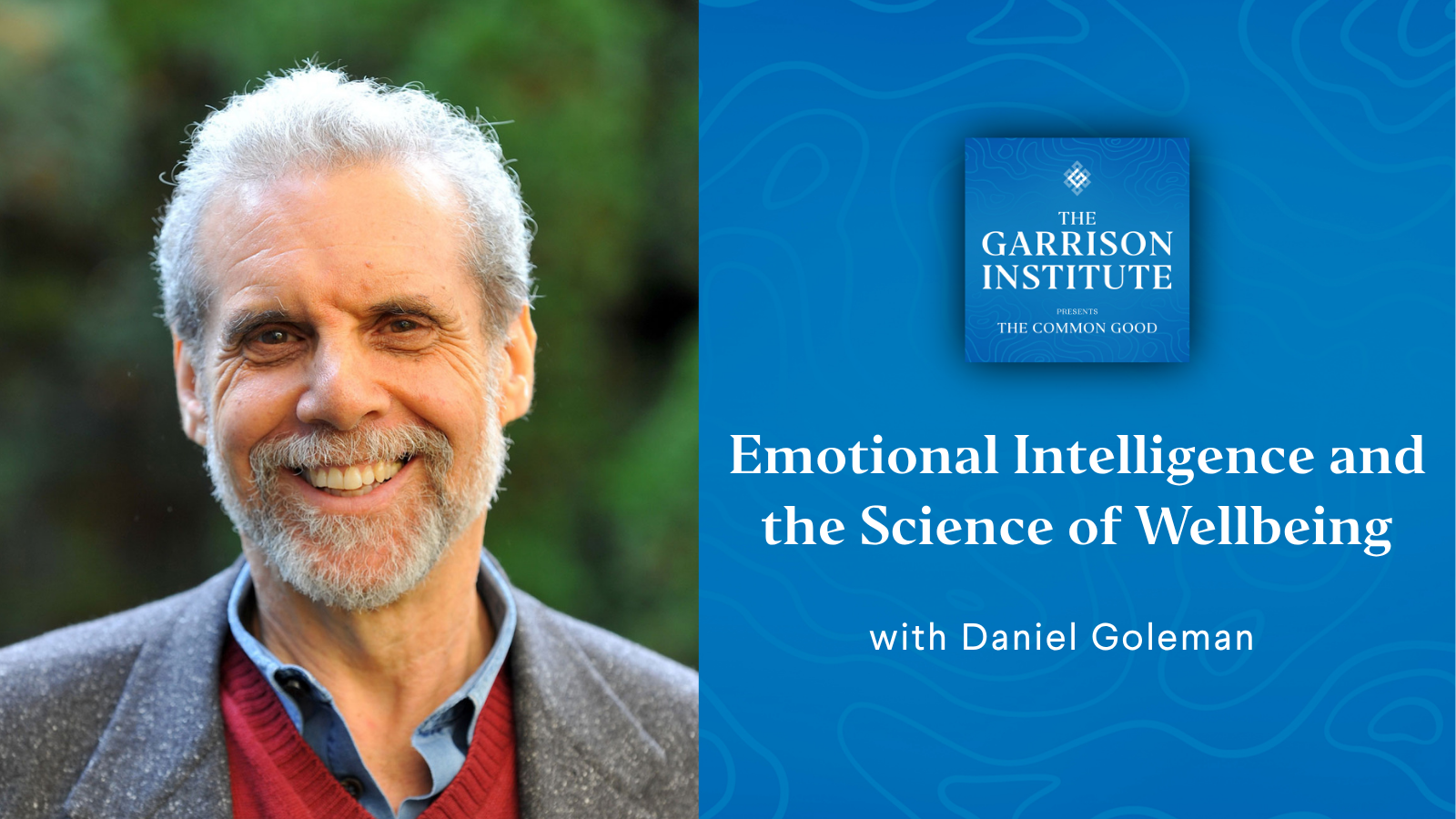
That question runs through Episode 11 of The Garrison Institute Presents: The Common Good, in which host Jonathan F.P. Rose speaks with Daniel Goleman, the renowned psychologist, science journalist, and author whose work on emotional intelligence has changed the way many people understand leadership, empathy, and human potential. Their conversation moves from Goleman’s early encounters with contemplative traditions to the neuroscience of attention, the emotional life of groups, and the possibility of economic and social systems rooted in care.
At its center is a simple but demanding proposition: The quality of our inner lives is not separate from the condition of the world around us. The way we manage attention, emotion, empathy, and responsibility becomes part of the social field we create together.
Goleman’s own path began within Western psychology. At Harvard, he studied clinical psychology in a field largely oriented around pathology: how to help people move from illness back toward normal functioning. But his time in India, and his encounters with Asian contemplative traditions, opened a different question. What lies beyond normal? What kinds of wellbeing, wholeness, generosity, and presence become possible when human development is understood not only as treatment, but as practice?
Rose names this as a form of “two-eyed seeing”: one eye trained by Western science, the other by contemplative and spiritual insight. Goleman’s work has often lived at that meeting point. As a science writer for The New York Times, he encountered the term “emotional intelligence” in an academic article by Peter Salovey and John Mayer. He recognized in it a bridge between psychological research, contemplative wisdom, and everyday human life.
Emotional Intelligence as a Bridge
In the episode, Goleman describes emotional intelligence through four interrelated capacities. The first is self-awareness: knowing what we are feeling and how those feelings shape our perception, thoughts, and impulses. The second is self-management: the ability to work skillfully with emotions such as anger, fear, anxiety, or discouragement, while staying oriented toward what matters.
The third is empathy, which Goleman distinguishes in several forms. Cognitive empathy allows us to understand how another person thinks. Emotional empathy allows us to sense how another person feels. Empathic concern goes further: It is the capacity to care about another person’s wellbeing.
The fourth capacity gathers these into relationship. Emotional intelligence is not simply private self-regulation; it is the ability to lead oneself while also attuning to others, communicating what matters, and helping people feel connected to a shared purpose.
That relational dimension is especially important for leadership. Goleman notes that emotions move through groups. A leader’s fear, anger, steadiness, or enthusiasm does not stay contained inside one person; it becomes part of the emotional climate of a team. Leadership, then, is not only a matter of strategy or efficiency. It is also a practice of presence.
For Rose, this marks one of the major cultural shifts Goleman’s work helped make visible. Once considered too soft for business schools and leadership development, emotional intelligence is now widely recognized as central to how people collaborate, make decisions, and carry responsibility.
From the Atomized Self to the Common Good
The conversation turns from individual leadership to a larger question: What happens when a culture becomes too focused on the separate self?
Rose reflects on the ways modern Western life has intensified individualism, consumption, loneliness, and a weakened sense of the commons. Even ordinary language separates “self” from “other,” when in reality each person lives within a web of relationships, communities, ecosystems, histories, and shared consequences.
Goleman responds by naming one of the deep aims of spiritual practice: becoming less self-focused and more open to the needs of others. In that sense, compassion is not an abstract virtue. It depends on the same capacities emotional intelligence requires: attention, empathy, care, and the ability to notice what is needed.
This is where personal practice and social responsibility begin to meet. If a genuine community is made of people who care about one another, then the erosion of care is not only a private problem. It becomes a public one. It shapes institutions, politics, economics, and the conditions under which people can belong.
Mindfulness as Attention Training
Mindfulness enters the dialogue not as a wellness trend, but as a practical way to strengthen attention and resilience. Goleman describes a simple practice: resting attention on the breath, noticing when the mind wanders, and gently returning. Over time, this repeated movement trains the mind to notice distraction and come back.
That may sound modest, but in a distracted culture it is no small thing. Goleman frames mindfulness as a form of attention training. It helps people become calmer and more focused, and, with practice, more able to recover from difficult emotional states. The point is not to become untouched by anger, fear, or stress. It is to be less frequently overtaken by them, less intensely captured by them, and more able to return.
The interpersonal dimension matters as much as the individual one. Mindfulness can help loosen judgment and assumption, making it possible to meet another person with greater openness. That openness is not passive. It is part of what allows compassion to become responsive rather than reactive.
For the Garrison Institute, this connection between contemplative practice and social life is foundational. Practice is not a retreat from responsibility. At its best, it refines the very capacities that make responsibility possible: attention, care, steadiness, humility, and the willingness to remain present in complexity.
The Inner Life of Systems Change
Rose brings this inquiry into economics through his work on meta-economics, a whole-systems approach that seeks to account for social wellbeing, individual wellbeing, planetary health, and the human relationship with nature. The current economic system, he notes, often treats individuals, firms, cities, and nations as isolated actors. That worldview has consequences: climate disruption, biodiversity loss, inequality, exploitation, and a narrowing of value to what can be monetized.
Goleman answers by returning to the people who inhabit systems. Systems are not only structures outside us; they are continually shaped by the actions, habits, values, and decisions of the individuals within them. If people are more self-aware, better able to manage themselves, and more genuinely concerned with the wellbeing of others, they are more likely to make choices that move systems toward care rather than extraction.
Rose presses the point further, arguing that individual wisdom alone is not enough. Social conventions, institutional incentives, shared norms, and collective moral intentions also shape behavior. Goleman agrees that these are different levels of the same phenomenon. Individual transformation and collective structures are not competitors. They are in constant feedback.
That feedback requires transparency. Goleman points to the hidden impacts of production, consumption, and business decisions: environmental costs, social costs, and planetary consequences that often remain invisible to the people making choices. Better information, he suggests, can help hold systems accountable. When people can see the true costs of what they buy, make, and support, they are better equipped to act from their values.
Practicing Wholeness Together
Toward the end of the episode, Rose asks what people can do in a world marked by isolation, loneliness, anger, and alienation. Goleman’s answer returns to practice, but not practice as an individual project alone.
The contemplative traditions offer methods for transforming the mind and heart. But they also place those methods within community: sangha, congregation, minyan, fellowship, or other forms of shared practice. Who we gather with shapes how we see the world. Practice can help people become less self-absorbed and more open to others, but community helps that openness take root in relationship.
The episode leaves listeners with a vision of wellbeing that is both intimate and collective. Emotional intelligence is not simply a tool for personal success. Mindfulness is not only a strategy for managing stress. Compassion is not merely a feeling. Together, these capacities form part of the inner infrastructure of a more ethical and resilient society.
To cultivate them is to practice a different relationship to the world: one in which awareness leads to care, care informs action, and action is held within a larger sense of responsibility for the common good.
Listen to the full conversation with Daniel Goleman on The Garrison Institute Presents: The Common Good.