What if business education began not with shareholder value, but with human and planetary flourishing?
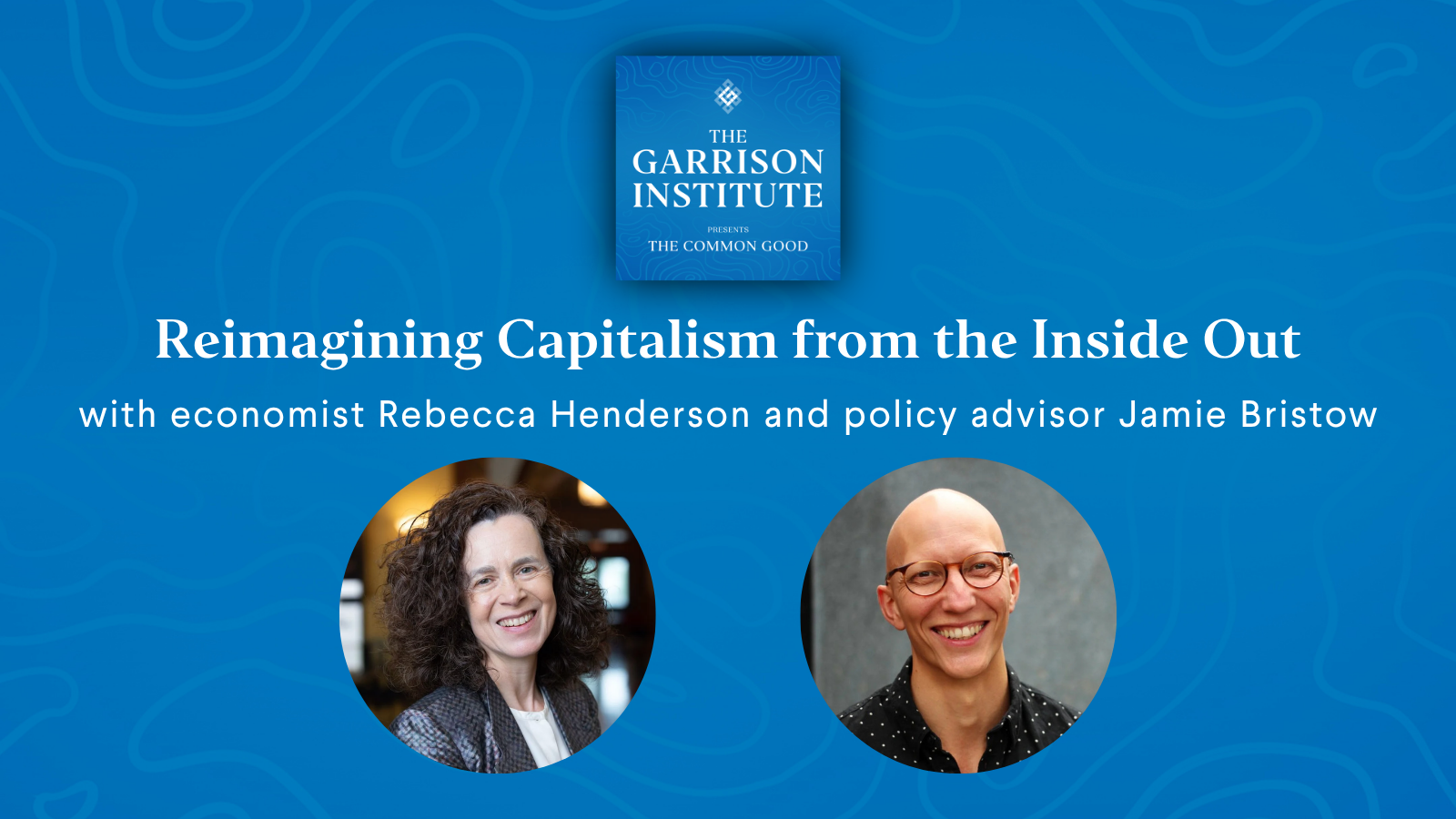
That question sits at the heart of Episode 13 of The Garrison Institute Presents: The Common Good, in which host Jonathan F.P. Rose speaks with economist Rebecca Henderson and policy advisor Jamie Bristow about what it might mean to reimagine capitalism through mindful leadership. The conversation moves across business schools, Parliament, contemplative practice, public policy, and the moral imagination required for systems change. Its deepest invitation is deceptively simple: If our institutions are shaped by the mindsets we teach and reward, then changing systems also requires changing the inner capacities of the people who lead them.
Henderson, a Harvard Business School professor and author of Reimagining Capitalism in a World on Fire, begins with a direct challenge to one of the most durable assumptions in modern business education – the purpose of business is profit. Profit, she argues, is necessary, but it is not the point. It is a means that allows businesses to serve something larger: communities, ecosystems, workers, customers, and the conditions for a thriving society.
This is not only a technical correction. It is a change in worldview. Henderson describes how students and executives often need to see real examples of purpose-driven leadership before they believe another model is possible. Theory matters, but embodied examples matter more. When business leaders who are successful, courageous, and heart-centered enter the classroom, they begin to loosen the assumption that care and competence belong in separate worlds.
Rose presses this point further by naming the dominant story of capitalism as a mental construct – one built around separateness, fear, greed, and relentless extraction. Henderson agrees that the crisis is not only economic, but also psychological and spiritual. The worldview that treats people, communities, and the natural world as external to business decision-making has become deeply embedded in how firms measure success, promote leaders, and define value. To reimagine capitalism, then, leaders must also examine the inner conditions that keep that worldview alive.
Mindfulness Beyond Personal Wellness
Bristow brings this inquiry into the public sphere through his work with the UK Mindfulness Initiative, where he helped introduce mindfulness to members of Parliament and supported the landmark Mindful Nation UK report. What began as personal practice among politicians gradually opened into a larger question: How might mindfulness shape public life, policy, education, health care, workplaces, and responses to the climate crisis?
In the episode, Bristow is careful not to reduce mindfulness to stress relief or individual wellbeing. He describes it as a foundational capacity that changes how we attend, relate, learn, and act. The quality of attention we bring to the world shapes every relationship we have – with ourselves, with one another, with institutions, and with the living Earth.
Yet Bristow also notes that mindfulness practice is shaped by the frame in which it is taught. If mindfulness is presented only as a personal tool, it may help individuals cope while leaving harmful systems intact. But when it is linked to relational awareness, compassion, and planetary wellbeing, it can become part of a wider education in responsibility.
The Work of Staying Present
One of the most powerful moments in the conversation comes when Henderson describes why mindfulness became essential to her own work. After her book was published during the COVID-19 pandemic, she found herself speaking with thousands of people about the scale of ecological, economic, and institutional breakdown. Intellectually understanding the crisis was not enough. She needed a way to remain present without shutting down, denying what she saw, or becoming overwhelmed.
For Henderson, mindfulness offered a way to stay with reality long enough for courage, patience, and love to become possible. That distinction matters. Inner work is not an escape from the world; it is part of what allows people to face the world without being consumed by fear or despair.
At the same time, Henderson insists that mindfulness alone is not enough. If people awaken inwardly but remain embedded in institutions that reward the same old assumptions, the systems will keep reproducing themselves. What is needed is a dance between inner development and structural transformation. Bristow names this as the integration of love and power.
Love, Power, and Systems Change
The word love appears in the conversation not as sentiment, but as a disciplined force for public life. Bristow reflects on how terms like mindfulness and compassion, once considered too soft for policy settings, have gradually become more legitimate. Love, he suggests, may now be at a similar threshold.
But love cannot be separated from power. Without power, love can remain abstract or ineffectual. Without love, power becomes domination. The work ahead is to cultivate leaders who can hold both: The fierce care required to protect life, and the practical skill needed to move institutions, resources, and policies.
That integration has direct implications for education. A curriculum for mindful leadership would teach systems thinking, economics, law, governance, accounting, and organizational design. But it would also cultivate relational capacities: awareness, care, courage, humility, and the ability to remain present in complexity. It would help students ask not only “How do systems work?” but “Who am I within them, and what kind of power am I willing to practice?”
This is where the episode connects deeply with the Garrison Institute’s broader work. Rose points to an emerging field of people and organizations linking inner transformation with outer change. Henderson and Bristow are not presenting a finished blueprint. They are helping name a field in formation – one that brings business educators, contemplatives, policymakers, investors, and social change practitioners into conversation around the capacities needed for a more compassionate and resilient world.
The Leverage Points We Can Reach
Toward the end of the episode, the conversation turns to leverage. Which groups, if reached and transformed, might help shift the wider culture? Henderson names senior business leaders, political leaders, and the next generation being educated to follow them. Rose widens the frame, noting that many different “one percents” matter: teachers, religious leaders, investors, parents, local organizers, and others positioned to influence the social fields around them.
Bristow adds that one of the missing ingredients in the ecosystem of inner-led change is funding. Promising ideas, practices, and interventions exist, but many remain at the margins because capital has not yet flowed toward them at the scale required. For those with resources, the invitation is not only to support change intellectually, but to direct power, influence, and money toward the conditions that allow it to grow.
The episode leaves listeners with a demanding and hopeful proposition: Capitalism, education, and leadership can be reimagined, but not by analysis alone. The work requires new stories, new institutions, and new habits of mind and heart. It asks us to see through the illusion of separateness and to act from a deeper recognition of relationship.
In that sense, mindful leadership is not a technique for becoming more effective within the old paradigm. It is a practice of becoming available to a different one.
Listen to the full conversation with Rebecca Henderson and Jamie Bristow on The Garrison Institute Presents: The Common Good, and read or download the full transcript.