By Gretchen Steidle
The inaugural Conscious Change Forum hosted by Garrison Institute’s Spirituality & Social Change initiative and the Conscious Change Collective brought together more than 100 people from at least 10 countries, including change leaders, funders, spiritual activists, and leading practitioners working at the intersection of inner work, spirituality, and social change. We build upon a long history of nonviolent and spiritually based movements for justice, faith lineages that have invested deeply in societal wellbeing, and Indigenous traditions where the spiritual and communal are inseparable.
The community that is coming together as part of the Conscious Change Collective now includes organizations with decades of experience in these spaces as well as many new organizations formed in the last five years, all incorporating contemplative practice and inner development deliberately into program delivery work, but not always connected to a larger whole. Across a diverse range of social issues, geography and populations, their work offers additional insights into the mechanisms by which inner work or contemplative practice functions in transforming society and systems.
The Conscious Change Forum was intended as an early opportunity for practicing organizations to meet, raise the visibility of the field, find common ground, and build the relationships from which a sense of collaborative purpose might grow. The event was a relatively short and intensely packed three-day gathering of speakers, exchange, and interactive engagements, leaving many with the desire for more – more time for contemplative practice, more time for relationship building, more space for integration, and more opportunity to connect as a whole community. Unquestionably, what also arose across the board was an energy for deepening and moving forward together. Early Forum feedback reveals:
- 47% of attendees feel much more part of a field of contemplative/spiritual/inner work and social change as a result of attending the Forum
- 42% feel somewhat more a part of such a field
- 11% feel no change in a sense of belonging
After hearing from so many people about why this movement needs each and every one of us, I realized I don’t need the “right” degree or title or anything like that, I can just be a part of it as I am. – Participant
Following is a recap of what unfolded during our three days together:
DAY 1
The first evening of the Forum opened with a ceremony led by Indigenous leaders, Shawn Stevens and Wanonah Kosbab of the Stockbridge Munsee band of the Mohicans, representing the original people of the land on which the Garrison Institute resides. Steve Varley, Managing Director of the Garrison Institute and Gretchen Steidle, Director of the Spirituality & Social Change Program welcomed participants. Gretchen spoke to the values of the Conscious Change Collective and Forum, including recognizing our interconnectedness, striving for equity, honoring the unique wisdom of our diverse lived experience, and embodying mindfulness, respect, compassion, and curiosity. She acknowledged the many voices still missing and invited the community to help in connecting the dots between other movements and communities like a “mycelial network.”
A six-person care team, designed and held the event architecture to provide peer support for individual and collective wellbeing throughout the Forum. Led by Ames Paulson, Founder of Healing Together; Leander Roth and Stas Schmiedt, Co-Founders of Spring Up; Dr. Patty Ramirez, founder of KLBRI; Francesca Raoelison, Founder of Omena, and Bianca Marks, the care team offered one-on-one and small group sessions to tend to tensions, emotional overwhelm, and any harm experienced within the space. The entire gathering was anchored by intentional Touchstones that invited participants to build relationships with compassion and care and to be co-stewards in tending the space in centering accessibility and wellbeing, honoring complexity and consent, and being present with curiosity.
An intentions altar set in the center of the meditation hall held participant intentions and a sacred chair represented those not present on whose behalf we would be gathering. Suzanne Bowles, of Cattail Strategy and Indigenous Commons, joined Shawn Stevens and Wanonah Kosbab to offer a Moonlight Receiving Ceremony under the stars, inviting the community, “especially those touched by Western economic narratives, to open our receiving channels so we can better engage in giving, gratitude, appreciation, peace and presence.” The practice gave participants the opportunity to be present with the unconditional gifts that the natural world offers us every day.
DAY 2
The first full day invited an exploration of the historical foundations of our current movement in three significant offerings. Host Rhonda Magee, Professor Emeritus of Law at the University of San Francisco set the stage inviting us to explore “what it means to build a field of conscious social change advocacy – bringing together spirituality and acting for a more just world, building resilience that is not limited to ourselves. And that is really courageous about changing structures to make all of us more capable of thriving.”
 Rhonda moderated a fireside chat between Deepak Bhargava, President of the Freedom Together Foundation and Michelle Alexander, author of The New Jim Crow: Mass Incarceration in the Age of Colorblindness and founder of Spirit of Justice. Deepak spoke of being mentored by the Reverend James Lawson in nonviolent traditions and collective liberation through engagement with people who are experiencing extreme oppression. He discovered how essential a reunion of spirit and justice is as a taproot for our collective liberation, explaining that the path of nonviolent movements have the largest track record of “receipts” – or efficacy – in achieving transformation. Michelle spoke of a radical love ethic that ensures we can be in right relationship with ourselves, others, and the natural world. Mentored later in life by the great historian and theologian Vincent Harding, she was challenged to name the deeper message beneath her advocacy: that true liberation work is about awakening to the sacredness and oneness of all human life. The message of Deepak and Michelle was clear – it is difficult to build resilient, courageous movements without a spiritual base.
 Five Indigenous elders, including Cheryl Fairbanks, Tlingit-Tsimshian Attorney and Tribal Court of Appeals Justice; Robert Yazzie, Chief Justice Emeritus of the Navajo Nation, Dr. Patty Ramirez, Xicana Indígena founder of KLBRI, along with Shawn Stevens and Wanonah Kosbab, co-founders of Red Road Reclamation, explored the sacred worldviews of their people. Cheryl spoke of how sovereignty begins at home and Robert shared how children come to recognize one’s sacred knowledge base “is in you. It’s just a matter of opening yourself.” Shawn Stevens relayed a story of the Creator’s message that we are all guests of Mother Earth, and invited us to live with values of love, patience, and respect for ourselves and others. Dr. Patty offered the teaching, “You are my other me, I am your other you,” expressing our interconnectedness and how our liberation is tied to one another. An Indigenous Peacemaking circle invited participants to explore their core values, and how to embody relationship as the primary organizing principle for solving problems collaboratively.
 Finally, Báyò Akómoláfé, Founder of the Emergence Network, author, and postactivist philosopher, invited the gathering to consider soul as an ecology and that our inheritance is not a smooth progression, but an eruption of hidden tensions that is magnetized to what is unfinished. He noted how we are trapped in death spirals like ants as we try to apply solutions as business as usual. Instead, Bayo explained, our job is not to be whole, but to be with the cracking open and love the pieces. “The pragmatic roads are no longer leading to interesting places…The things we have to do we know nothing about. The call can’t come from us.” He spoke of the cracks – the spaces of incompleteness and disruption, and the places where identity and certainty break apart — as the spaces where real transformation becomes possible.
The Forum thereafter gathered in small groups called Seed Pods to connect more deeply and integrate the provocative talks of the day. Ames Paulson, Founder of Healing Together, led participants through a composting ritual to let go of what was no longer needed. Offerings written on natural paper will be regeneratively composted this spring and incorporated into a sunflower field. Participants were invited to invest in communities of care through contemplative practice and relationship building in the downtime. A beautiful Gratitude Wall built by Sandra Ortiz and Katia Dumont, Co-Founders of AGUA ensured each attendee received messages of how their presence had brought value and touched others within the space.
The livestream of Day 2 of the Forum, moderated by Nichol Chase, Garrison Institute Fellow, with support from Dan Wolpert and Adam Sher, provided a window into the Forum for those who could not attend in person. Nichol also provided space for connection and guided Social Presencing Theater practice with participants.
DAY 3
 In the second full day, the community met to explore who we are as a field and to
invite clarity around our emerging future. The Forum was joined by Kelvy Bird, Co-Founder of the Presencing Institute, who brought forth through generative scribing a visual representation of the emergent themes unfolding throughout the gathering.
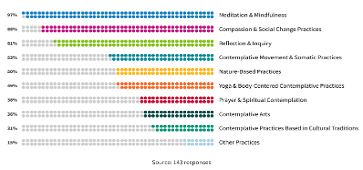
Gretchen Steidle led participants through an interactive exploration of the field according to modality, issue, and collective needs. Participants gathered in small groups to share about contemplative approaches to systems change and co-create a giant tree representing the field. Sara Taggart of Inner Work Strategy & Learning and Matt Hawkins, Co-Founder commonplace, presented highlights from the Conscious Change Collective map data from 168 organizations who completed profiles. Key data insights include:
What range of contemplative/inner work/spiritual practice modalities do you use as an organization? (select any)
Values We Share


We will be sharing more from our research in the coming days for broader dialogue.
Time was also spent immersing in small groups to explore participant-proposed questions and interest areas, such as how to build new relationships with funders, how to bring youth into the movement, and ways to communicate our work with new audiences. Eddie Harris and Matt Hawkins, Co-Founders of commonplace, with Katia Dumont, Co-Founder of AGUA hosted a large group dialogue on creating the conditions for transformation, fostering connection, and exploring the contradictions in the field. Chief Justice Yazzie offered the Four Directions as a sacred approach to understanding balance in solutions-building.
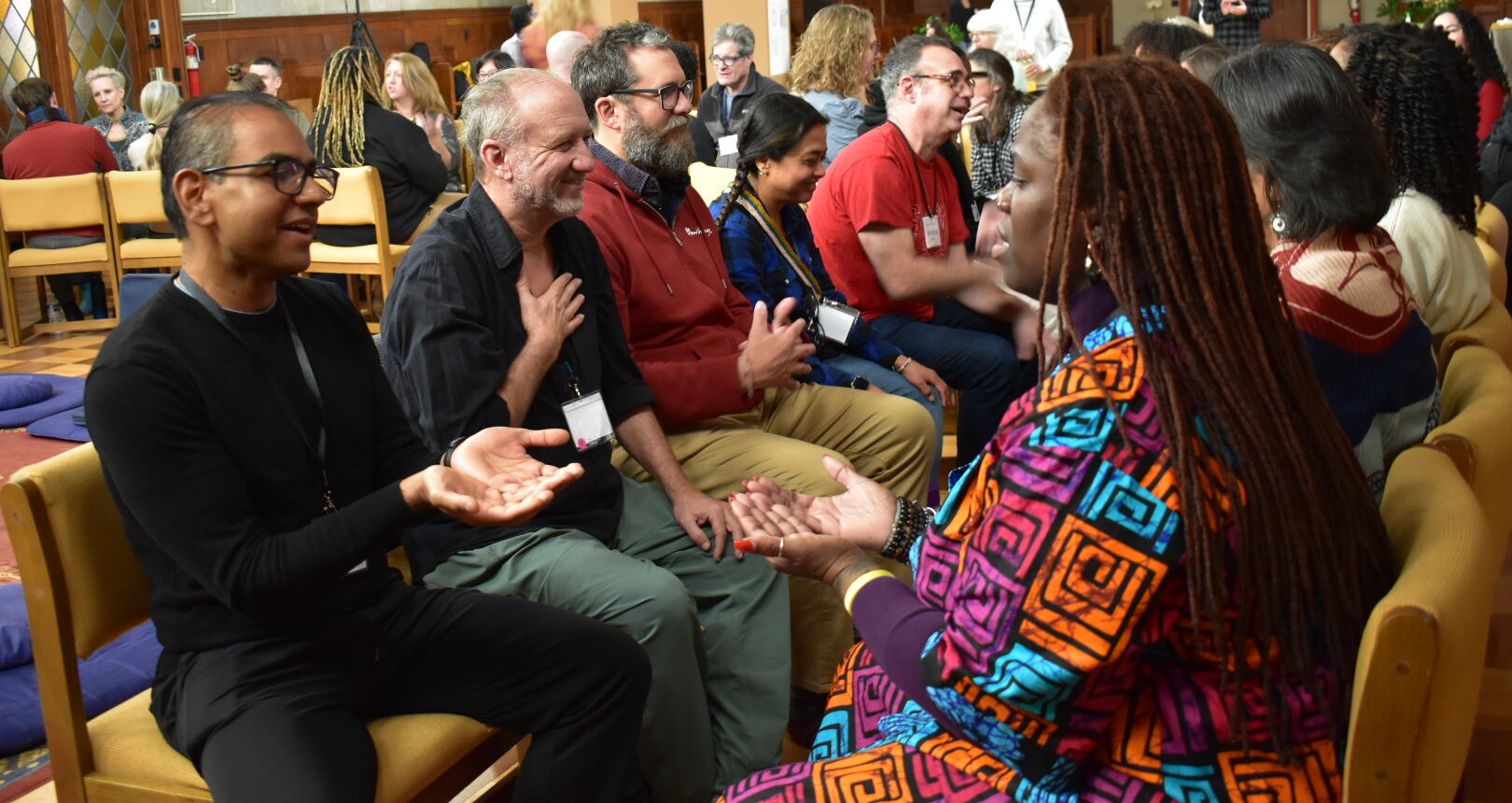
Embodied reflection and circle processes wove through the days, attempting to model the inner-outer integration that this field embraces. Spiritual leaders offered opening and closing rituals from a variety of faith traditions, including Rabbi Nate DeGroot, Director of the Shalom Center, and Ishwar Bidgelal of Hindus for Human Rights.
Participants shared a range of morning practices, including meditation from Cathy-Mae Karelse of the Mindful Initiative’s Climate Youth Resilience program and Holly Rogers and Libby Webb, co-founders of the Mindfulness Institute for Emerging Adults. Jessica Dibb of the Inspiration Community and Gretchen Steidle offered breathwork. Bianca Marks and Brialle Ringer offered yoga, while Dan Wolpert, founder of the Minnesota Institute of Contemplation and Healing, and Fruzsina Molnar, Garrison’s Senior Development & Strategics Project’s Manager both shared forest bathing.
Finally, Chun Dong of Intelli Alliance Foundation shared KAN-LI Energy Nourishing Strategy and Katia Dumont of AGUA offered conscious stream writing. In the evenings, a fire gathering, storytelling, song, talent offerings, and nourishing food, allowed participants to deepen relationship with each other and the land.
DAY 4
 The final half-day created space in a large circle for participants to reflect on their experiences, consider the research, and explore the future of the field and their contributions towards that vision. Clear themes emerged, including:
- Strategy to channel our intention, draw more people in, and take practical action together
- A community of spiritual practice
- Ways of looking at truths with love and holding ourselves accountable
- A toolkit to talk to the “non-weird”
- Alternative economic models to resource the field
- Healing and care for our community
- Gathering and convening more often to be in spaces of emotional alchemy
- Sense-making and sharing research and wisdom
- Being willing to explore big ideas and questions that were once not safe to explore
- Exploring decentralized governance for the movement
- Grief rituals and composting of what is no longer needed
- Exploring stories together and shaping new narratives
- Building the connective tissue or spiritual infrastructure grounded in ecological belonging and relationship for this field
What’s Next
The Conscious Change Collective is now actively building the infrastructure to support this field — connecting nearly 400 organizations doing this work, deepening research, and creating pathways for resource-sharing, collaboration, and mutual support. Immediate next steps to build upon the momentum of the Forum will include:
 Monthly Tending the Field virtual calls as a space of spiritual practice and connection, meeting at 8am PT / 11am ET / 3pm GMT the last Wednesday of the month. We would love to rotate guidance of these calls from among our Collective members. Please let us know if you are willing to guide a practice.
REGISTER
Monthly issue-focused group calls will explore contemplative approaches to systems change, including:
- Education and working with youth
- Planetary health
- Criminal justice reform and violence prevention
- Democracy
- Health and wellbeing
Each collaboration circle is exploring different avenues for supporting each other’s work and wisdom. Some are interested in crafting an article to share insight around their unique approaches, others are supporting each other’s work in practical ways, and others are interested in building case studies to share. If you are interested in joining any of these issue-focused groups or initiating another, please contact Gretchen@garrisoninstitute.org.
In the coming weeks, we will begin to explore building a toolkit for sharing evidence, language, and case studies for this field, crafting a communications platform to support connection, and exploring alternative models for resourcing this field. We will be sharing more of our initial insights from our research for your discussion and input as well. And we will soon be designing a webinar series and podcast, called “Inner Works” to elevate case studies and models of spiritually-based models for social change.
If you have an interest in getting more involved, please contact Gretchen@garrisoninstitute.org and apply here to join the Collective.
We wish to extend our deepest gratitude for the volunteer members of our organizing team for their extensive time and care and our funders for their generous investment in making this convening possible:
VOLUNTEER ORGANIZING & SUPPORT TEAM
Nichol Chase, Contemplative-Based Resilience Initiative and Garrison Institute Fellowship, Garrison Institute
Suzanne Bowles, Founder, Cattail Strategy and Kinmaker, Indigenous Commons
Rabbi Nate DeGroot, Director, The Shalom Center
Sandra Ortiz Diaz, Co-Steward AGUA
Katia Dumont, Co-steward AGUA
Eddie Harris, Co-Founder, commonplace
Matt Hawkins, Co-Founder, commonplace
Claudia Horwitz, Facilitator, trainer, writer and faculty with Casey Foundation; founder of stone circles
Bianca Marks, consultant, educator, Yoga teacher, and NGO Professional
Amy Paulson, Co-Founder & CEO, Healing Together
Dr. Patty Ramirez, DSW, Founder & CEO, KLBRI
Francesca Raoelison, Founder & CEO, Omena
Leander Roth, Co-Founder, Spring Up and Bluelight Academy of the Liberatory Arts
Stas Schmiedt, Co-Founder, Spring Up and Bluelight Academy of the Liberatory Arts
Adam Sher, Board of Directors, The Shalom Center and Ayin Press
Gretchen Ki Steidle, Director, The Garrison Institute Spirituality & Social Change Program and Founder,
Circles for Conscious Change
Sara Taggart, Founder, Inner Work Strategy and Learning
Daniel Wolpert, Co-Founder, Minnesota Institute of Contemplation and Healing
SPECIAL GUESTS, SPEAKERS, CONTEMPLATIVE PRACTICE FACILITATORS
Bayo Akomolafe, Ph.D., Founder, The Emergence Network
Michelle Alexander, Scholar in Residence at Union Theological Seminary
Deepak Bhargava, President, Freedom Together Foundation
Ishwar Bridgelal, Hindus for Human Rights
Cheryl Demmert Fairbanks, Esq. Attorney and Tribal Court of Appeals Justice
Jessica Dibb, Inspiration Consciousness School & Community
Chun Dong, Founder, Intelli Alliance Foundation
Cathy-Mae Karelse, Climate Youth Resilience, The Mindfulness Initiative
Wanonah Kosbab (Spencer) Co-Founder, Red Road Reclamation
Rhonda V. Magee, M.A., J.D., Professor Emeritus of Law, University of San Francisco
Fruzsina Molnar, Garrison’s Senior Development & Strategics Project’s Manager
Brialle Ringer, certified yoga practitioner
Holly Rogers, Co-Founder, Mindfulness Institute for Emerging Adults
Shawn Stevens (Standing Eagle) Co-Founder, Red Road Reclamation
Libby Webb Co-Founder, Mindfulness Institute for Emerging Adults
Robert Yazzie, Chief Justice Emeritus of the Navajo Nation & Associate Professor of Law Advocate,
Navajo Technical University
HOST ORGANIZATIONS
The Garrison Institute’s Spirituality & Social Change Program
Circles for Conscious Change
Freedom Together Foundation
The Vista Hermosa Foundation
The Conscious Change Collective is a field-driven endeavor. Since February 2023, it has been envisioned, designed, and guided by a community of 40+ Senior Advisors and Field Co-Creators – representing practitioners, activists, researchers, philanthropists, networks, and thinkers from seven countries on four continents working across a range of social issues.