The Fullness of Emptiness
Emptiness, a fundamental teaching in Mahayana Buddhism, might feel like a tough idea to chew on. It’s an insight that can feel more sobering than soothing at times, and it’s no stranger to misinterpretation.


Category

Emptiness, a fundamental teaching in Mahayana Buddhism, might feel like a tough idea to chew on. It’s an insight that can feel more sobering than soothing at times, and it’s no stranger to misinterpretation.

Two decades ago, at a colloquium on haiku poetry, I found myself sitting next to a Japanese poet during a lecture by a psychologist on “Haiku and the Practice of Mindfulness.” In chatting with him beforehand, I noticed that he understood English perfectly well but struggled a bit to speak it.

The inaugural Conscious Change Forum hosted by Garrison Institute’s Spirituality & Social Change initiative and the Conscious Change Collective brought together more than 100 people from at least 10 countries, including change leaders, funders, spiritual activists, and leading practitioners working at the intersection of inner work, spirituality, and social change. We build upon a long history of nonviolent and spiritually based movements for justice, faith lineages that have invested deeply in societal wellbeing, and Indigenous traditions where the spiritual and communal are inseparable.

By John Kania, Radha Ruparell, Peter Senge, and...

Lovingkindness practice asks us to embrace our shared humanity with all people, but it does not require us to agree with all of their actions.

This particular time of year feels like nothing so much as that brief moment of stillness between inhalation and exhalation, the equilibrium point between expansion and contraction, that brief instant of stasis and silence that comes with every breath.
The Conscious Change Collective provides a new social systems map of organizations applying contemplative practice for social transformation as well as a community working toward transforming consciousness.

Heartbreak finds us all, there is no escaping it. No matter how righteously we try to live, wounding can show up in forms we recognize and forms we don’t. We inherit the pain of human relationships and other unintegrated trauma channeled through the violence of world systems, generational trauma, family breakups, fractured friendships, and the tender emotional imprints left in us from intimate partnerships.
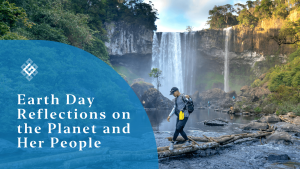
As we honor this year’s Earth Day celebration, we find ourselves reflecting on human relationships with nature and the complex ecologies that have supported life on Earth for millions of years. As a species, it’s clear we face a quandary rooted in mindsets that separate people and nature. However, cultivating gratitude, community resilience, and deep relationship with the land offers a hopeful path for a more harmonious future.
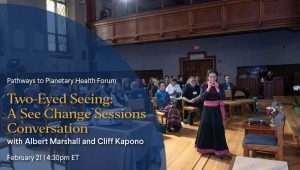
The Pathways to Planetary Health initiative partnered with See Change Sessions to introduce the power of applied contemplative practice to a new diverse audience at the February 2024 See Change flagship event in Vermont.
This partnership helped a community of change agents engage with contemplative practice to develop insight into inner change, embrace innovative social presencing practices, and build capacity for collaboration and compassion while addressing today’s pressing social and environmental issues.

Sometimes we are supposed to be falling rather than standing upright. I am thinking of the life cycle of a leaf. A portion of a leaf’s life span consists of being firmly rooted on the branch of a tree, while at some point in time, the season comes where the leaf falls from the tree to the earth. If I could put myself in the experience of the leaf for a moment, I imagine the liminal moment between the leaf being firmly attached to the branch and the leaf finding itself unfastened by this uncontrollable gravitational pull to the earth, a moment of grief and fear. I understand our human lives to be similar to that of a leaf.