Apprenticing to the Wild
Kurt Hoelting and Stephen Posner explored what it means to apprentice to the wild—a lifelong practice of cultivating presence, resilience, and belonging in relation to both inner and outer wildness.


Category

Kurt Hoelting and Stephen Posner explored what it means to apprentice to the wild—a lifelong practice of cultivating presence, resilience, and belonging in relation to both inner and outer wildness.

The Garrison Institute’s Spirituality & Social Change Program seeks to make visible, learn from, and catalyze a generative field at the intersection of contemplative practice, spirituality, and social change.

If there’s a tug of curiosity or the sense of spiritual longing, the assumption that “I can’t do” something is an obstacle of our own making that is worth investigating.

On July 9, we had the pleasure of hosting a Garrison Institute webinar with author and teacher Ethan Nichtern. If you’re familiar with Ethan’s teaching from The Road Home podcast or perhaps his essays on Substack, you can appreciate him for his clear, contemporary voice on spirituality.

With deep gratitude and sorrow, we honor the life and legacy of Joanna Macy, PhD—environmental activist, scholar, teacher, and beloved friend—who passed away peacefully on July 19, 2025.

Feeling the weight of global and personal unrest, writer Mary DeTurris Poust came to the Garrison Institute for our 2025 retreat honoring the work of Father Thomas Keating, a Trappist monk, leader of contemplative inter-spiritual dialogue, and founder of the Centering Prayer movement.
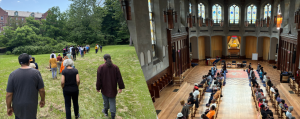
I sat in the meditation hall, bringing awareness to my in and out breath as the sunlight streamed in from the stained glass windows.
As the bell sounded and we began to walk around the meditation hall together in silence, I looked at the beautiful sangha that surrounded me and was overwhelmed by the amount of warmth, support — and most importantly, safety.

How do we connect to our inner – and collective – strength during these challenging times?
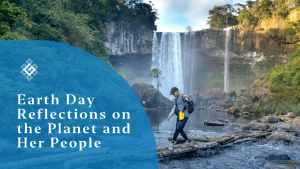
As we honor this year’s Earth Day celebration, we find ourselves reflecting on human relationships with nature and the complex ecologies that have supported life on Earth for millions of years. As a species, it’s clear we face a quandary rooted in mindsets that separate people and nature. However, cultivating gratitude, community resilience, and deep relationship with the land offers a hopeful path for a more harmonious future.

In a world grappling with rapid and...

Sometimes we are supposed to be falling rather than standing upright. I am thinking of the life cycle of a leaf. A portion of a leaf’s life span consists of being firmly rooted on the branch of a tree, while at some point in time, the season comes where the leaf falls from the tree to the earth. If I could put myself in the experience of the leaf for a moment, I imagine the liminal moment between the leaf being firmly attached to the branch and the leaf finding itself unfastened by this uncontrollable gravitational pull to the earth, a moment of grief and fear. I understand our human lives to be similar to that of a leaf.

We cannot solve complex sustainability issues using the approaches we’ve employed in the past. We need different approaches – and different mindsets – than those we’ve drawn on thus far.
These approaches and mindsets emerge from looking inward at the same time as we make outer change – from reflecting deeply on what’s here now as we grapple with complex and persistent predicaments like climate change and nature loss, social justice, trauma, and exploitative economic systems.